The TIA-598 color order
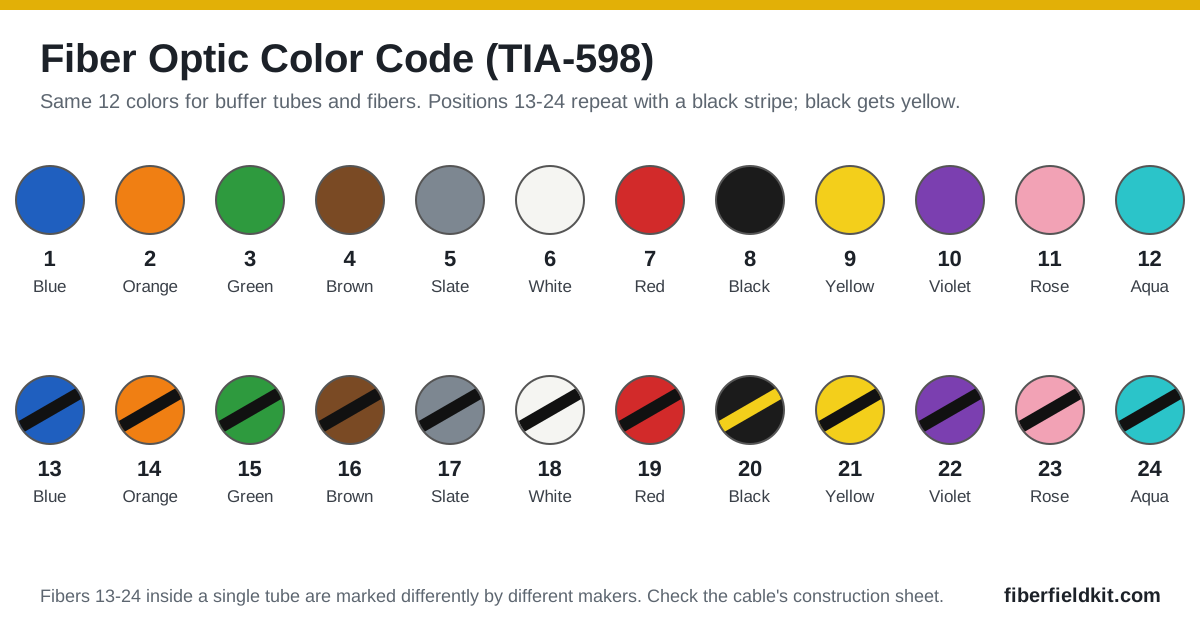
Buffer tubes and the fibers inside them use the same twelve colors in the same order: blue, orange, green, brown, slate, white, red, black, yellow, violet, rose, aqua.
| # | Color | # | Color (13–24) |
|---|---|---|---|
| 1 | Blue | 13 | Blue with black stripe |
| 2 | Orange | 14 | Orange with black stripe |
| 3 | Green | 15 | Green with black stripe |
| 4 | Brown | 16 | Brown with black stripe |
| 5 | Slate | 17 | Slate with black stripe |
| 6 | White | 18 | White with black stripe |
| 7 | Red | 19 | Red with black stripe |
| 8 | Black | 20 | Black with yellow stripe |
| 9 | Yellow | 21 | Yellow with black stripe |
| 10 | Violet | 22 | Violet with black stripe |
| 11 | Rose | 23 | Rose with black stripe |
| 12 | Aqua | 24 | Aqua with black stripe |
How to find any fiber
For a cable with 12 fibers per tube, the tube is the fiber number divided by 12, rounded up. The position inside the tube is what is left over.
Tube = ⌈fiber ÷ 12⌉ · Position = ((fiber − 1) mod 12) + 1
Worked example
Fiber 40: 40 ÷ 12 = 3.33, so it is in tube 4, brown. Three full tubes hold fibers 1 to 36, so fiber 40 is the 4th fiber in tube 4: brown. Fiber 40 is brown in brown.
Fiber 87: 87 ÷ 12 = 7.25, so tube 8, black. 7 × 12 = 84, so it is the 3rd fiber: green. Fiber 87 is green in black.
Tubes 13 and up: stripes
When a cable needs more than twelve tubes, tubes 13 to 24 repeat the twelve colors with a black stripe or dashes. Tube 20 would be black on black, so it gets a yellow stripe instead. Tube 13 is blue with a black stripe, tube 20 is black with a yellow stripe, and tube 24 is aqua with a black stripe.
Past 24 tubes there is less agreement. A common convention, used by Prysmian among others, repeats the colors again with a red stripe for tubes 25 to 36, with red itself (31) getting yellow. Very high counts usually group tubes into colored binders instead. Treat anything past tube 24 as "read the construction sheet".
Fibers 13 to 24 inside one tube
Cables with 24 fibers per tube also mark fibers 13 to 24, but makers do it differently: black dashes, rings or a stripe, and fiber 20 is often left natural (clear) rather than black with a yellow mark. The lookup shows the stripe convention and warns you to check. On these cables the construction sheet is not optional.
Charts by fiber count
- 144 fiber color code chart: 12 tubes of 12 fibers.
- 288 fiber color code chart: 24 tubes of 12 fibers, with striped tubes 13 to 24.
Smaller counts are the first rows of the 144 chart: a 48-count cable with 12 fibers per tube is tubes 1 to 4 (blue, orange, green, brown), and a 96-count is tubes 1 to 8.
Check the cable before you cut. Not every cable is 12 fibers per tube. Some smaller cables use 6 per tube (a 48-count may be 8 tubes of 6), ribbon cables put 12 fibers in each ribbon and number the ribbons, and very high counts group tubes into binders with their own colors. The manufacturer's construction sheet for that cable is the final word, and fillers (blank tubes) are not counted.